Average annual employer sponsored insurance deductible
Measure Overview
Most health insurance plans require plan enrollees to pay a set amount of money, known as a “deductible,” out of pocket before the plan begins to pay for covered health services. In recent years, deductibles have increased due to rising deductible limits within plan types as well as higher enrollment in high-deductible health plans (HDHPs). Plans with higher deductibles can work well for healthy individuals who may not have many out-of-pocket costs, but they can also potentially cause delays or avoidance in seeking care for those who worry about affordability. Monitoring trends regarding access to care as deductibles rise may offer insights both about affordability of care as well as how delays in care may contribute to poorer health outcomes or higher instance of disease in the long term.
State Health Compare provides annual state-level measures of employer-sponsored insurance (ESI) based on findings from the Medical Expenditure Panel Survey – Insurance Component (MEPS-IC).* The estimates presented on this page pertain to private sector workers who receive health insurance through their employer and have a deductible. Data are available for single plans and family plans.
*As SHADAC and other organizations have documented, the COVID-19 pandemic was the cause of several substantial disruptions to data collection efforts for the 2020 MEPS-IC, which may have potential impacts on 2020 single-year estimates of annual average ESI deductibles. Researchers should approach using 2020 data with caution, and SHADAC will continue to monitor any future changes to federal data releases directly or indirectly related to the pandemic.
State Health Compare provides annual state-level measures of employer-sponsored insurance (ESI) based on findings from the Medical Expenditure Panel Survey – Insurance Component (MEPS-IC).* The estimates presented on this page pertain to private sector workers who receive health insurance through their employer and have a deductible. Data are available for single plans and family plans.
*As SHADAC and other organizations have documented, the COVID-19 pandemic was the cause of several substantial disruptions to data collection efforts for the 2020 MEPS-IC, which may have potential impacts on 2020 single-year estimates of annual average ESI deductibles. Researchers should approach using 2020 data with caution, and SHADAC will continue to monitor any future changes to federal data releases directly or indirectly related to the pandemic.
Generate customized graphics using this data by selecting one of the options below.
Related Products
Rising Health Insurance Costs: Family Employer-Sponsored Insurance (ESI) Premiums Grow at Over Twice the Rate Seen Last Year
SHADAC has tracked trends in ESI health insurance costs for years using the latest Medical Expenditure Panel Survey–Insurance Component (MEPS-IC) data. We are continuing our coverage with this analysis of recently released 2025 MEPS data, finding that ESI family plan premiums grew at over twice the rate seen last year—read full blog for details and findings.
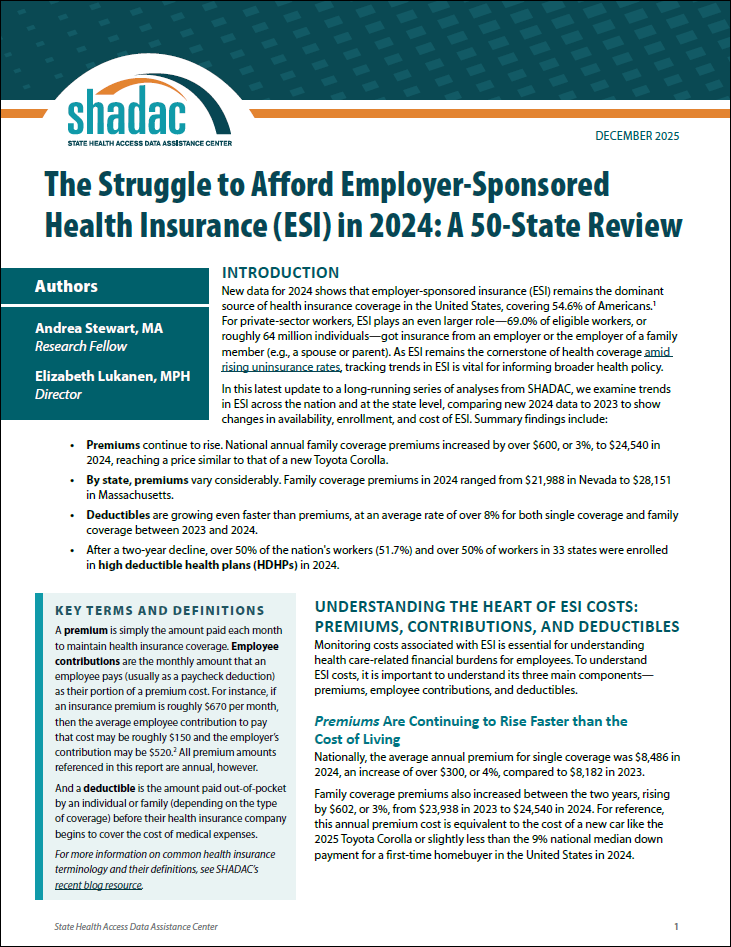
ISSUE BRIEF—The Struggle to Afford Employer-Sponsored Health Insurance (ESI) in 2024: A 50-State Review
In the latest brief from a long-running series, SHADAC researchers use estimates from the Medical Expenditure Panel Survey-Insurance Component (MEPS-IC), produced by the Agency for Healthcare Research and Quality (AHRQ), to look at national and state-level ESI access, enrollment, and cost data in 2024 as compared to the prior year.