Percent of workers in establishments that offer coverage
Measure Overview
Employer-sponsored insurance (ESI) is health insurance coverage offered to qualified employees by employers; ESI has historically covered the majority of the U.S. population, with 61.7% of the non-elderly population enrolled in ESI in 2024.
However, not all employers offer health insurance coverage to their employees, which may present challenges to individuals who must seek health coverage elsewhere or be uninsured. Tracking rates of workers offered insurance coverage by their employer allows researchers and policymakers to identify states and populations that have lower access to employer coverage and to consider policies to expand access or assist individuals in enrolling in coverage elsewhere.
Percent of Workers in Establishments that Offer Health Insurance Coverage by State: Breakdowns and Data Source
State Health Compare provides annual, state-level rates of workers in establishments that offer coverage using data from the Medical Expenditure Panel Survey Insurance Component (MEPS-IC).
This measure can be broken down by firm size: Fewer Than 50 Employees and Greater Than 50 Employees.
Generate customized graphics using this data by selecting one of the options below.
Related Products
Rising Health Insurance Costs: Family Employer-Sponsored Insurance (ESI) Premiums Grow at Over Twice the Rate Seen Last Year
SHADAC has tracked trends in ESI health insurance costs for years using the latest Medical Expenditure Panel Survey–Insurance Component (MEPS-IC) data. We are continuing our coverage with this analysis of recently released 2025 MEPS data, finding that ESI family plan premiums grew at over twice the rate seen last year—read full blog for details and findings.
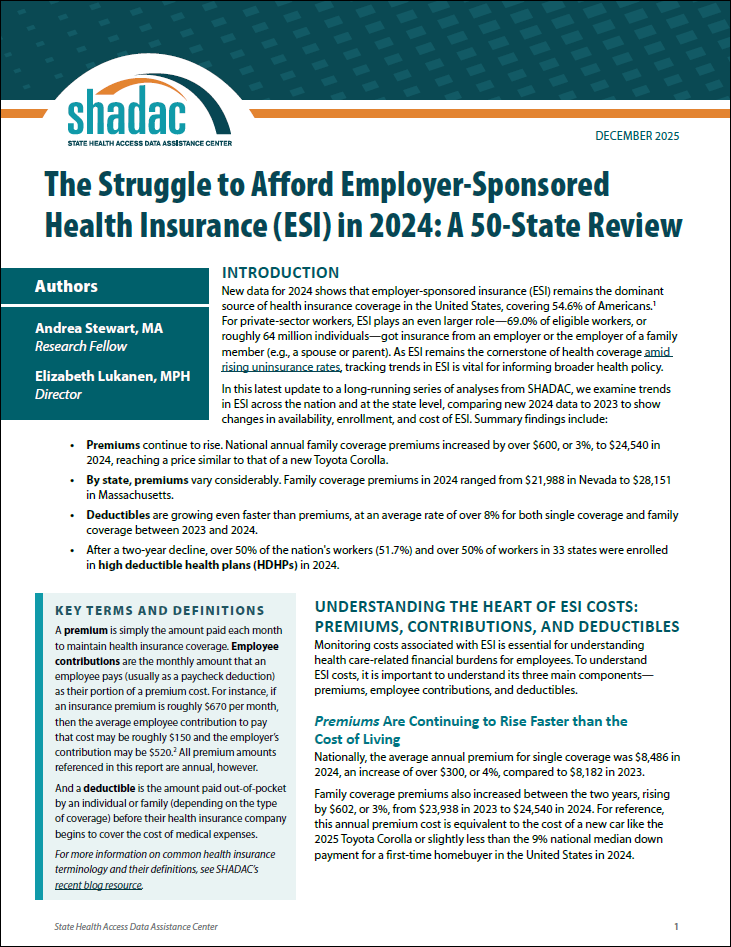
ISSUE BRIEF—The Struggle to Afford Employer-Sponsored Health Insurance (ESI) in 2024: A 50-State Review
In the latest brief from a long-running series, SHADAC researchers use estimates from the Medical Expenditure Panel Survey-Insurance Component (MEPS-IC), produced by the Agency for Healthcare Research and Quality (AHRQ), to look at national and state-level ESI access, enrollment, and cost data in 2024 as compared to the prior year.